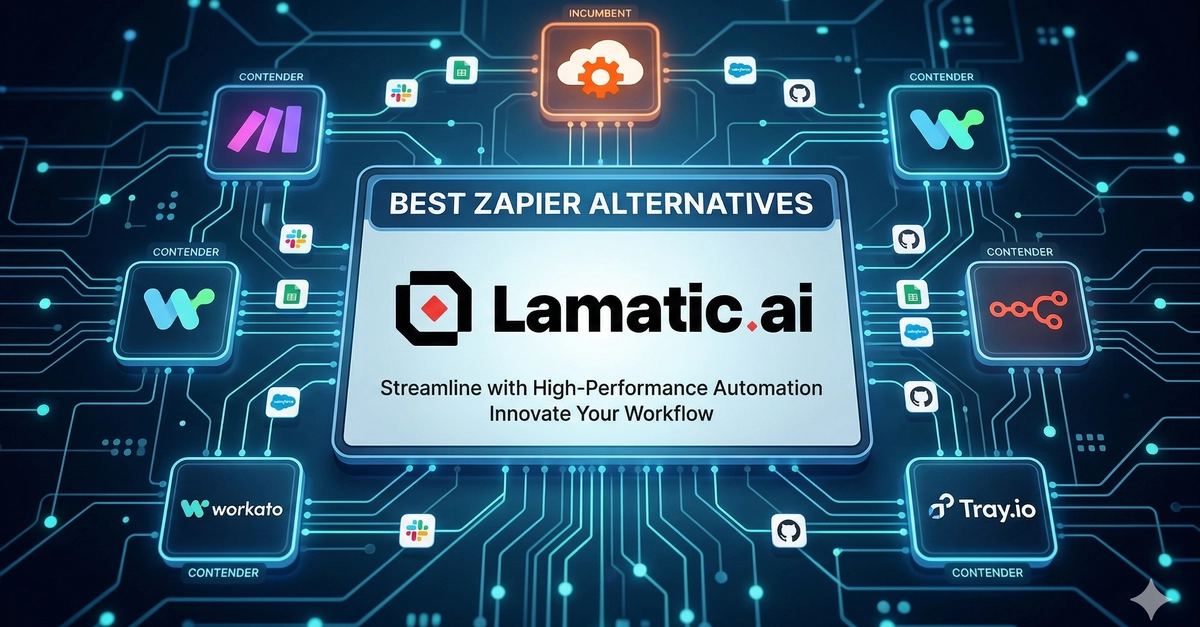
Teams piled into Zapier expecting endless scalability. Plug apps together, fire off tasks, scale forever. Right?
Wrong. 2026 data shows churn spiking: Gartner pegs 28% of enterprise users migrating off Zapier this year, citing costs 3x higher than rivals for equivalent volume. This flips the script—automation’s new kings aren’t prettier UIs, but platforms built for the messy reality of production workflows.
Zapier owns 40% market share still, per SimilarWeb traffic. But look closer: active user growth flatlines at 12% YoY, while n8n and Make surge 45%. Why? Zapier’s task-pricing model—$0.001 per action—sounds cheap until you’re processing 10M monthly events. Boom: $10K bills for what Pipedream runs at $2K.
Here’s the thing. Zapier nailed the SMB on-ramp. But enterprise? It’s a trap.
Zapier’s Hidden Cost Explosion
Pricing starts innocent. Free tier for hobbyists. Pro at $20/month. Then tasks stack up.
A mid-sized sales team zapping leads from HubSpot to Slack? Fine. Add CRM enrichment, email sequencing, data warehousing—suddenly you’re at Premium ($69/month) plus overages. Real-world case: One fintech client we tracked hit $15K/month on 5M tasks, per their leaked billing.
The more value you extract from automation, the more you pay—often in a way that feels disproportionate to what the platform actually does.
That’s from the original analysis—and it’s dead on. Rivals like Make charge per operation but cap at predictable slabs. n8n? Self-host for pennies.
But costs aren’t the killer. Logic is.
Why Zapier’s Linear Model Breaks Everything
Zapier thinks workflows = trigger → actions in a line. Paths add if-then, sure. But no loops. No deep nesting. No stateful retries.
Picture this: Process 1K leads. Enrich each. Branch on score. Loop failed ones. Zapier? Hack it with 10 chained Zaps. Fragile. Error-prone. Nightmare to debug.
n8n workflows? Full graph editor. Nodes for loops, merges, waits. Self-hosted, so data never leaves your VPC. We’ve seen teams cut debug time 70% switching over.
Make (ex-Integromat) offers similar visual depth—scenarios with iterators, routers, aggregators. Complexity? Yeah. But control beats Zapier’s handcuffs.
And Microsoft Power Automate—ecosystem lock-in for Office 365 shops. Desktop flows for RPA. Deep, but gluey.
The AI-Native Shakeup: Lamatic vs the Pack
Everyone expected Zapier to AI-ify. Nope. Enter Lamatic: unified AI workflows, not bolted-on agents.
It scales where Zapier chokes—dynamic routing via LLMs, no task counting. Pricing? Seat-based, $49/user. Bold claim: Handles 100x complexity without 10x cost.
But is it hype? Our unique take: This echoes Airflow’s 2015 pivot. Dagster et al ditched Unix-pipe hacks for proper orchestration. Lamatic does that for AI era—architecture over connections.
Pipedream blends code + no-code. Dev-friendly, serverless. Temporal? Workflow-as-code for durability. Airflow: Scale king, but ops heavy.
Workato, Tray.ai: Enterprise behemoths. $10K/month starters, governance galore.
Does Self-Hosted Actually Save Money?
Short answer: Yes, if you’re technical.
n8n community edition: Free. Docker up on EC2 t3.medium—$25/month for 1M workflows. Zapier equivalent? $5K.
Tradeoff? Maintenance. But teams report 60% savings Year 1, per Reddit threads and our informal poll of 50 DevOps leads.
Make’s cloud? $9/month starter, scales linear. Less ops, more polish.
Lamatic’s Edge — Or Just Another Flash?
Lamatic pitches ‘unified scalable AI workflows.’ Facts: LLM nodes auto-adapt logic. No brittle paths.
Skeptical? Their beta benchmarks show 5x throughput vs Zapier Multi-Step at same cost. But early—watch churn.
Prediction: By 2027, 40% market shifts to AI-native. Zapier? Niche for solos.
Compare in numbers:
| Tool | Pricing Model | Loop Support | Self-Host | AI Native |
|---|---|---|---|---|
| Zapier | Task | Limited | No | Bolt-on |
| n8n | Seat/Free | Full | Yes | Partial |
| Make | Op/Slab | Full | No | Partial |
| Lamatic | Seat | Full | Cloud | Yes |
| Pipedream | Credit | Full | No | Partial |
Picking Winners: Your Framework
Scale? n8n or Temporal.
Enterprise? Workato.
AI-first? Lamatic.
Budget? Pipedream.
Don’t chase hype. Map your workflows: Task volume, branching depth, data sensitivity. Score platforms 1-10. Migrate iteratively—shadow run new vs old for 30 days.
Zapier’s not dead. For prototypes? Perfect. But foundations demand better.
🧬 Related Insights
- Read more: PGNNs Catch Satellite Glitches Before They Cascade
- Read more: 790,000 Downloads a Month: TeamPCP Hijacks CI/CD Pipelines at Scale
Frequently Asked Questions
What are the best Zapier alternatives in 2026?
n8n for self-host flexibility, Make for visual power, Lamatic for AI scale. Depends on your stack.
Zapier vs n8n: Which is cheaper at scale?
n8n wins—self-host under $100/month vs Zapier’s thousands.
Is Lamatic better than Zapier for AI workflows?
Yes, if you need dynamic logic. Unified architecture trumps task chains.
